
Covering the history and significance of Tamralipta in the last post (link) was an eye opener for I myself was ignorant about this historic place. Its contribution in uplifting the regional and international trade was paramount for Indian sub-continent and that’s why its important to understand them as well. So, through this post, I will attempt to highlight the connection between Tamralipta and a region close to my heart, Bihar.
As a resident of North Bihar, I have always heard exaggerated versions of how people from Patna would travel to Nepal in the olden days, and vice versa. While as a child, I was definitely fascinated by them, but it always felt far-fetched as my young mind was not able to comprehend the reality of how people could travel a distance so great and cross the expanse of a great river i.e. Ganga, without the modern means of transportation. Of course, these were the thoughts of a child for I have been able to shed all my apprehensions after spending a lot of time researching on this topic. There are various historical records which talks about the trade routes in ancient India, and they are corroborated by the travelogues of scholars who visited the Indian subcontinent from different countries. Travelogues of Fa-Hien and Hiuen Tsang are counted among those records as they do not only provide an insight into the political and cultural scenario of that time but gives an accurate description of the trade routes which existed. They have also captured in detail the routes they traversed in the subcontinent, which is helpful in drawing connections between different places, apart from their link with the main trade routes.
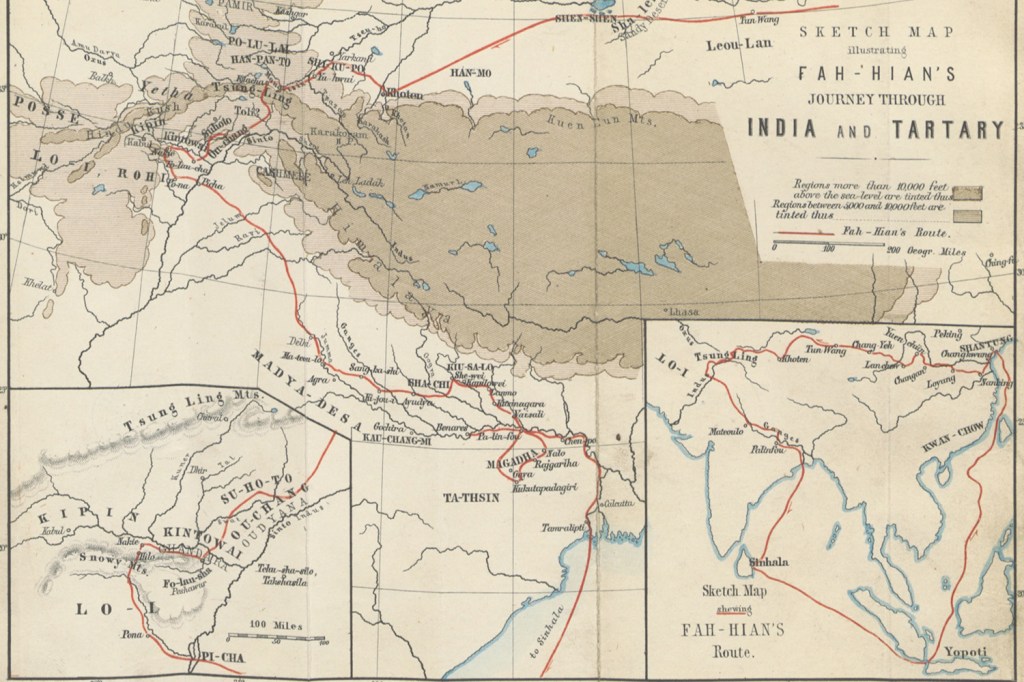
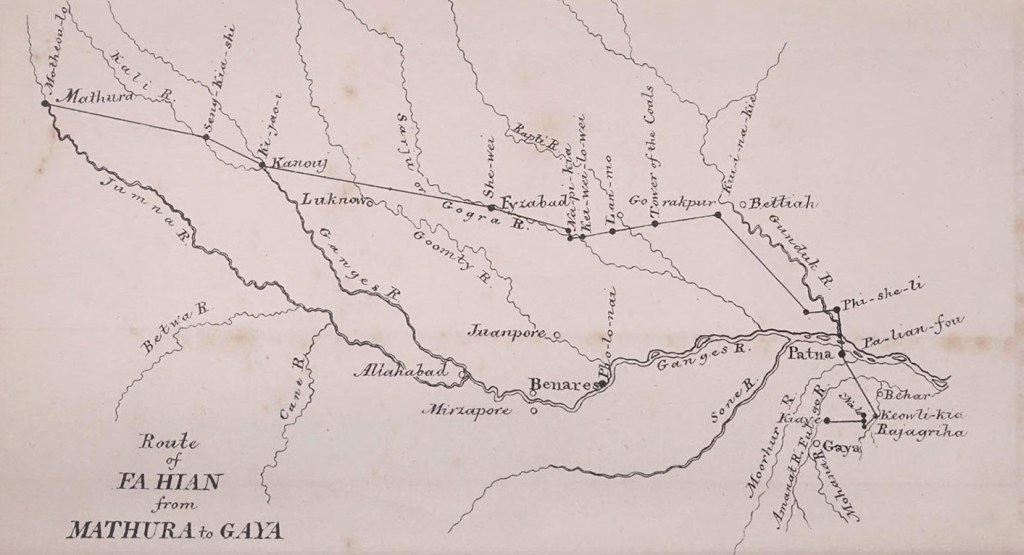
Fa-Hien entered Bihar via northern regions which led him to Vaishali, where he crossed Gandak River to reach Kushinagar and further west. He crossed Ganga and followed the road of Pataliputra-Nalanda-Rajgriha (Rajgir) and reached Gaya. He also followed the Champa-Tamralipta route to embark on his further journey to Ceylon (Sri Lanka). Route followed by Hiuen-Tsang is complicated as he crossed Ganga from some where near modern Arrah to follow the route of Varanasi-Vaishali. After reaching Vaishali, he traveled to Mithila and then to Nepal. He went to other areas of Bihar, traveled through river from Bodh Gaya to reach Champa and from there he went to Tamralipta.
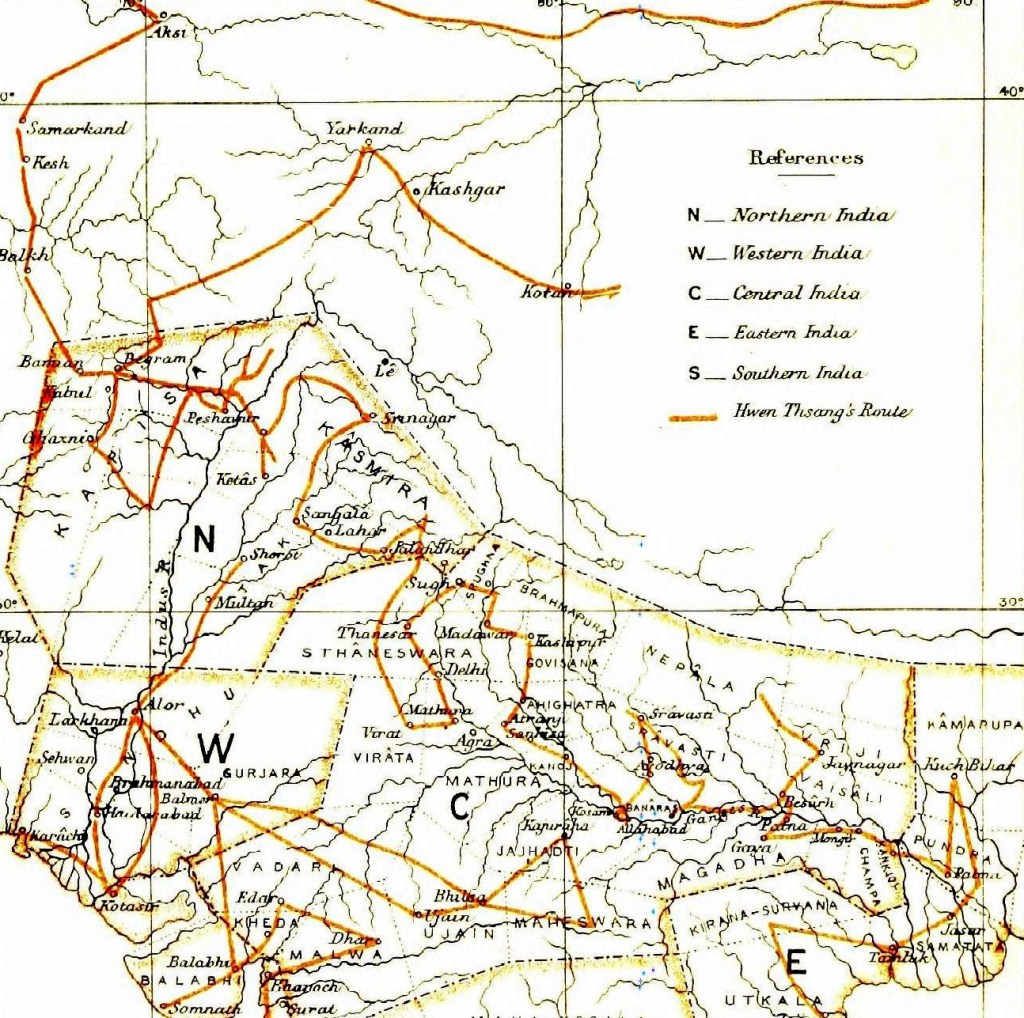
So, if we were to accurately describe these routes, connection of Tamralipta with Bihar was through Uttarapatha (now known as Grand Trunk Road), a route which connected North India. Off-shooting from the main Silk Road at Balkh (presently in Afghanistan), Uttarapatha passed through Taxila, Punjab, Delhi, and Mathura, where it bifurcated. One route went southwards, to Ujjain and other commercial centers of south-western India, and it was named as Dakshinapatha. The other went towards present area of southern Bihar, where it was joined in by a secondary route coming from Pataliputra, and culminated at Tamralipta.
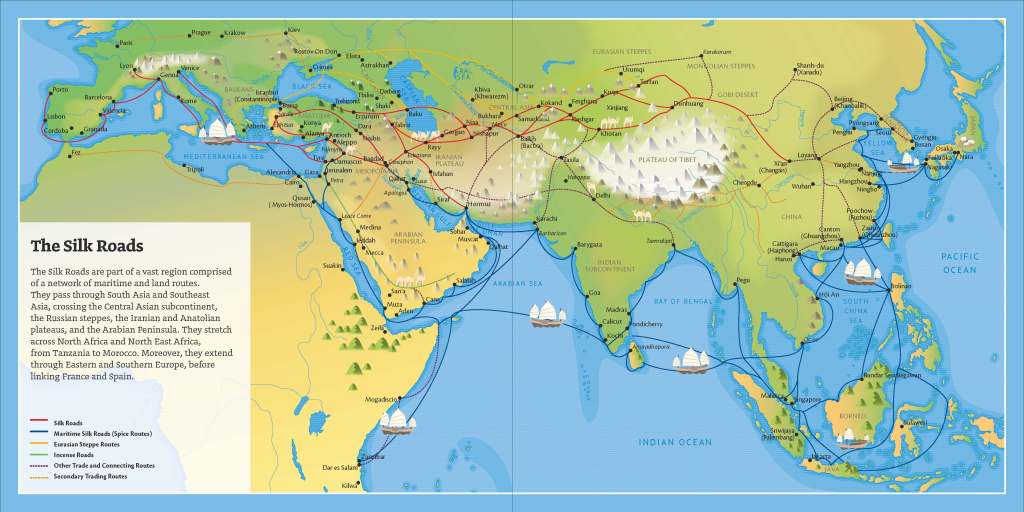
Source – https://en.unesco.org/silkroad/about-silk-roads
From Pataliputra, there were two routes that terminated at Tamralipta; one which merged into Uttarapatha and the other which headed eastward before reaching the port city. The first route went from Pataliputra to Nalanda, then passed through the important centers of Rajgir, Gaya, Taradib, and Hazaribagh before merging into Uttarapatha. The second route went from Pataliputra to Munger, then Champa (or Bhagalpur), and passed through the settlements of Lakhisarai, Kanjol, and Mangolkot before reaching Tamralipta. A trade route ran from Sravasti (in U.P.) to Rajgriha, passing via Kapilvastu, Kushinagar, Pava, Hathigama, Vaishali, and across Ganga to Pataliputra. Settlements of Northern Bihar were connected via two major cities i.e. Chirand (in Saran district) and Vaishali[i]. While these two areas were connected to the larger route by Gandak and Ganga River, Vaishali had connections with Nepal via a highway which went till Lauriya Nandgarh and then bifurcated. Role of rivers in strengthening the route can never be denied as international trade of Champa, Pataliputra, and Vaishali were carried through Ganga which eventually led to Tamralipta. Local trades were carried out by rivers such as Gandak, Kosi, Son, and Mahananda.
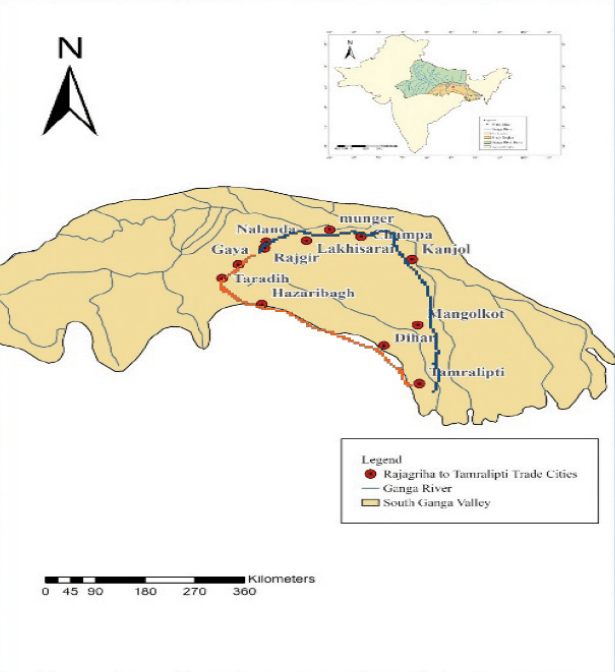
Source – Jayasuriya, Kasun. (2023). Tracing the Ancient Trade route from Rājagṛiha to Tāmraliptī during the period of 3rd Century BCE to 6th Century CE. 2. 121-138.
Although, through this post I have attempted to cover the major connections between Bihar and Bengal, some of them might have been left out because it’s rare for research to be full proof. So, if I come across any such information, I will definitely do a well-researched post on it. Till then, do keep a look out for the next post, and of course, Happy Reading!
[i] There might have been more trade centres in Northern Bihar, but I have found very few references till now.
Featured Image Credit – Painting by Thomas Daniell, sourced from British Library
Sources:
- Kumar, Anil. “MARKET CENTRES AND TRADE ROUTES IN LATE ANCIENT BIHAR.” Proceedings of the Indian History Congress 67 (2006): 131–44. http://www.jstor.org/stable/44147930.
- Jayasuriya, Kasun. (2023). Tracing the Ancient Trade route from Rājagṛiha to Tāmraliptī during the period of 3rd Century BCE to 6th Century CE. 2. 121-138.
 Echoes of Time
superior! Famous DJ’s Virtual Concert Draws Millions 2025 exceptional
LikeLike