
Most of us take pride in where we come from and where our roots are, but for some it becomes difficult. It becomes difficult when you belong to a place which has constantly been derogated in the conversations of a ‘civilized’ society. In the last few posts, I have spoken at length about how I love my hometown in Bihar, and I take pride in the historical narratives that have unfolded in the state. Of course, there are a lot of issues with the place, but it is also blessed with several virtues. The love and acceptance that I have now has come only in the past few years once I have started understanding the place. Hence, I am on a mission to spread this love and acceptance by reminding everyone that ‘let’s not judge a book by its cover!’
So, what is this post about? This post is about my hometown in Bihar, once a quaint little town, which has expanded into a city in the last decade. The name Hajipur is credited to Haji Ilyas or Shamshuddin Ilyas, the king of Bengal, who is said to be the founder of this town. However, the place is mentioned in ancient texts where it is said to be a part of Harihar-kshetra. Presently, the region of Harihar-kshetra is synonymous with the twin towns of Hajipur and Sonepur which are situated across the historic city of Patna and at the confluence of Gandak with Ganga River.
But what is Harihar-kshetra and how is it relevant in this story?
The story of Hajipur is intricately linked with the ‘tale of Gaj and Grah’. This tale starts at Triveni Dham (located on the border of Nepal and Bihar, near the present town of Valmiki Nagar), where it is said that a fight broke out between the lords of forest and water, i.e., the Gaj and Garah, the elephant and the crocodile. Reference to this story is found in Srimat Bhagvada Gita[1], which narrates that one day a huge elephant came with his herd to bathe in the river[2]. It was the place where the lord of water or the crocodile lived. Seeing the elephant, he caught him by the leg and tried to drag him into deeper water. This struggle continued for thousands of years when at last, the elephant started praying to Lord Vishnu or Hari. His prayer was heard, and Hari saved him from the grip of crocodile in presence of other gods. While the fight started at Triveni, due to the flow of Gandak, it ended at Harihar-kshetra i.e., the place where Hari appeared[3].
Today, this tale is not only the identity of Hajipur but of Sonepur as well.

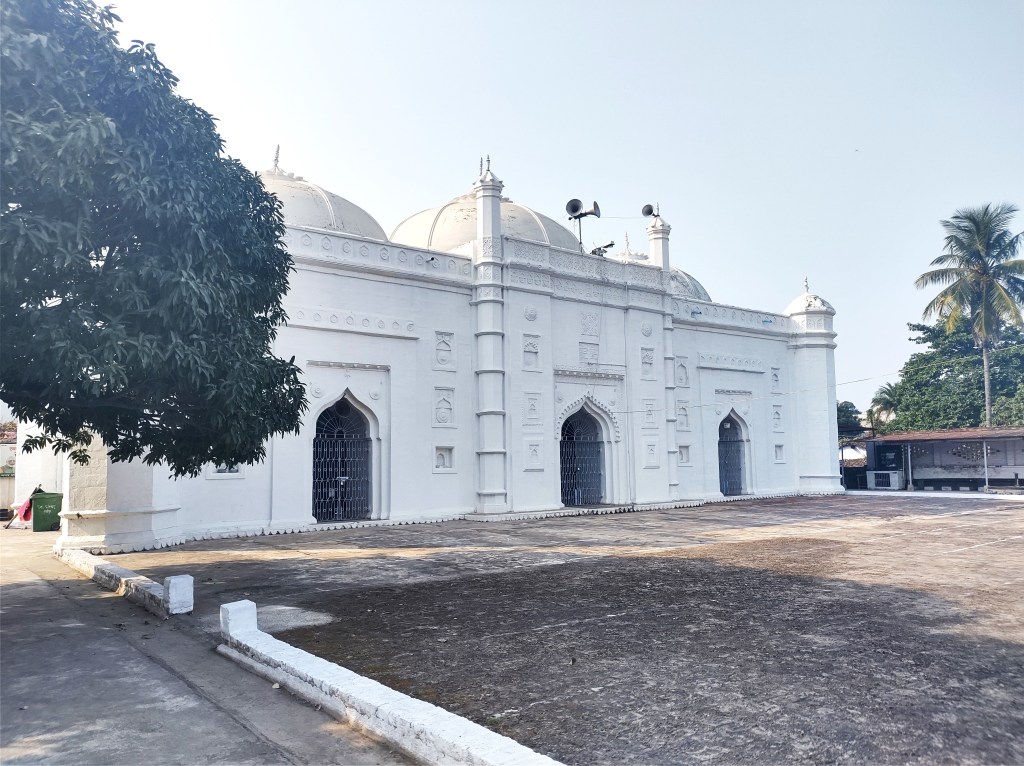
Owing to the location, this region has benefited in several ways as it was traversed by saints and scholars and it has been a hub of trade and cultural exchange. Hajipur is believed to be the seat of sages or rishis of ancient times[4]. It was traversed by Ram and Lakshman while they were on their way to Mithila and was also visited by Lord Buddha whenever he was in Vaishali (presently the village of Basarh). Hajipur as a town was established between 1345 CE to 1358 CE on the eastern bank of Gandak by Haji Ilyas or Shamshuddin Ilyas, the king of Bengal. He built an elaborate fort on the bank of Gandak, ramparts of which were visible until a few years ago. In the enclosure of the fort, a mosque was constructed by Maksus Shah in 1587 CE which came to be known as Jama Masjid or Pathar Masjid.
Locals say that in 17th and 18th century, several ghats and temples were constructed along the river but most of them were laid to waste in the massive earthquake of 1934 C.E. Some of them have still survived today like the Nepali Mandir, Hajuri Math, and Sidhi Ghat.

During British rule, several social and utilitarian infrastructure were developed in the town. Bridges connecting the Hajipur with Sonepur were built on Gandak which included a railway bridge as well. Also, a school, several bungalows, a racecourse, and dance club were constructed along the river but due to change in course of the river everything except the school was devoured by the river in 1837 C.E[5]. Learning from their mistake, the British officials conducted the next bout of construction of bungalows, dance club, and other infrastructure in Sonepur and away from the river.
While this post is enough to narrate a brief story for the settlement, it won’t be able to accommodate tales of the heritage sites situated in Hajipur. So, keep reading and stay tuned for the next post!
- Bhagavad Gita, often referred to as the Gita, is a 700-verse Hindu scripture that is part of the epic Mahabharata, dated to the second half of the first millennium BCE and is typical of the Hindu synthesis.
- Chaudhary, P. C. (1962). District Gazetteer of Champaran. Patna
- Ibid
- Ibid
- Ibid
 Echoes of Time
I have penned down this emotional note because, the topic (Hajipur) you have chosen holds a special place in my heart. I am 30 now, and have spent close to two decades (mostly childhood) in Hajipur, and I still can’t forget how balloons, bubble wands, baby elephants, and joy rides in Sonepur mela brightened up my November.
Post my 5th grade till post graduation, i have been away from Hajipur, and it was only during the summer vacations/Durga puja holidays when I had the privilege to spend my time here.
Now that I could never go back to Bihar, I really miss the bananas, lychee, pandal hoping, thekua, Gudri, Saraswati puja celebration, eating out at Anamika and Biscoman bhawan, teenage dates in Patna zoo, family picnics in Vaishali.. ahh, the list goes on.
Even today, when I communicate in Hindi, people identify me as a Bihari. And guess what? I take great pride in it.
P.S. I am sorry that I got carried away, and couldn’t add anything on the historical aspects. As for me, Hajipur isn’t just a place.. it’s a feeling.
LikeLiked by 1 person
Thank you such a heartfelt comment, it means a lot. Glad you liked the post, I hope to share more such stories in the future.
LikeLiked by 1 person
Feeling bad after reading this ,,,even being from sonpur I don’t know much about hajipur and sonpur ,🤧I dream to visit other cities but now it realises that I haven’t visited my hometown yet…🥲
LikeLiked by 1 person
Thank you for the comment. It’s certainly my aim to shed light on history of such places which are not widely known. I hope with these posts you will get to know a little more about your hometown.
LikeLike
a well written, educative blog… but please also mention about the historical sites related to the maurya dynasty in Hajipur… more about the licchviss of Vaishali, importance of Vaishali with regard to Buddhism … it will make the blog more enlightening and enriching
LikeLike
Hi, thank you for the kind words. I have covered about the history of Vaishali in another post. Please read the blogpost titled ‘Ruins of Vaishali’, I hope you will find the post informative.
LikeLike