
The year of 2022 brought with itself a little surprise for me; a surprise that helped me embark on a journey that I will cherish for a lifetime. In the month of August, as I was scrolling through the posts of Instagram, I came across a post by SPRF (Social Policy Research Foundation), inviting applications for the third edition of Water Seekers’ Fellowship. The fellowship is a brainchild of SPRF and Living Waters Museum at IISER Pune, in collaboration with esteemed organisations like World Wide Fund for Nature (WWF India), and Centre for Policy Research. It was the theme of the year FLOWING RIVERS that caught my eye, and I immediately knew that I had to apply.
While I did have conviction, there was an absence of a concrete proposal; all I had was a hazy idea related to a river that I had grown up watching. I have been born and brought up in a small town of Bihar known as Hajipur. The town has historical importance due to its geographical location i.e., at the confluence of two mighty rivers of Northern India – Ganga and Gandak. The flow of Gandak is north to south while Ganga flows eastwards forming the shape of an inverted T (or a T-junction). These two rivers have interlinked the fate of three settlements – Hajipur located on eastern bank of Gandak, Sonepur located on western bank of Gandak, and Patna or Patliputra located on southern bank of Ganga.
Although, I was aware of all these facts, I had never looked at the larger picture. I had never tried to understand the origin of a river that was so important to us, I had never tried to unfold the secrets that Gandak held in its depth, and I had never envisioned the significance of this river as a transboundary element. It was in July of 2022 when I visited Valmiki Nagar – a quaint little town in Bihar located at the border of India and Nepal. It was here that I saw a completely different side of Gandak – as a river that treads down from hills of Nepal and transcends the boundary made by humankind. So, when in August I saw the post of ‘Water Seekers Fellowship’ with the theme of ‘Flowing Rivers’, I took it as a sign to explore the story of Gandak.
River Gandak, also known as the Kali Gandaki or Narayani, has its origins near Tibet-Nepal border after which it enters Nepal from the Mustang region. After traversing through the lands of Nepal, it crosses Indo-Nepal Border at Triveni Dham and reaches Valmiki Nagar (famous for its Tiger Reserve) of Bihar. From Valmiki Nagar, Gandak winds its way through the states of Uttar Pradesh and Bihar before merging into Ganga at Hajipur and Sonepur. The river is home to several endangered species which thrives extremely well in its ecosystem, and it includes Gharial, Gangetic Dolphins, and Turtles. While several mythological stories have been related to Gandak which gives the river a sacred significance, it also has a rich history in terms of the historic settlements that have evolved on its bank or in its vicinity. The river and these settlements in its vicinity tell an extremely different story of Northern Bihar, a story which is not unexplored but is not known in the wider circle.

Those three months of the fellowship were an eye-opener as I was introduced to many aspects of the river that were beyond my comprehension. Given the time frame and other limitations of the program, I had limited the research to the stretch of Gandak that fall into political boundary of India. However, the fellowship has sparked my interest in uncovering the transboundary narrative of the river and it will be the journey of a lifetime.
I decided to summarise all the information that I had managed to collect in three months and present it as a story of Gandak – from origin to confluence. I wanted this narrative to flow like a river, hence the medium of prose poetry was chosen. Never in my life did I think of writing a form of poetry, but I gave my best shot. Here it goes………
Named as Kondochates by Greek geographers
I have been identified as the ever-flowing river of epics
They say that I travel through three different countries
But my course has not known any boundaries
I identify myself with mountains, gorges, and plains
As they are the highlights of my journey
Before I reach my final destination

Owing to the relatively unchanged nature of the ecosystem
Gangetic dolphins, turtles, gharials, and mahseer
Have always been companions in my journey

Association with the stories of different faith
Has given me a sacred status
The name Narayani is owed to the presence of ammonite fossils
Also known as shaligram,
the fossils are venerated as Hindu god Vishnu or Narayan
Puranic legends of Gaj-Grah and travels of Buddhist Guru Rinpoche
Have linked me to the two oldest religions of the world

Originating from the snowy mountains of Mustang
I travel southwards through the gorges of Dhaulagiri, Manaslu, and Annapurna
My entrance to Indian sub-continent is at Triveni Dham
It is here that I am renamed as Gandaki or Gandak
It is here where the story of Gaj-Grah starts
It is here when I finally escape the narrow gorges of mountains
And spread my banks to see the plains of Bihar and Uttar Pradesh
It is here that I am welcomed by rivers of Sumeshwar Hills
Panchnad and Sonaha, as they accompany me in rest of the journey

After Triveni, I pass through Valmiki Nagar
Or as it was called originally, Bhainsalotan
the village known for its tiger reserve
is also linked with stories of Rishi Valmiki
Said to be the original site of Valmiki Ashram
The forest around the village has ruins of an old temple

Leaving the last views of mountains of Nepal
I move forward to explore the plains
In the plains I catch a glimpse of Burhi Gandak
A part of me that was left behind thousands of years ago
When I decided to shift my course westwards

Although the current scenery for the rest of the journey is almost the same
With small towns and agricultural lands lining my banks
There once was a time when my banks were adorned with mango groves

I have always been fascinated by the transient nature of humans
For it has resulted in wonderful creations
One such wonder is the land route developed in the plains of Bihar
A route parallel to my course
A route facilitated by my waters and abundant groves
A route that connected capitals of Vriji Republic and Magadha
To the mountainous region of Nepal
A route which was turned into Imperial highway by Ashoka
A route that is lined with Ashokan Pillars and Buddhist Stupas
Mainly at Basarh, Kesariya, Areraj, Lauriya Nandangarh
But the one at Rampurva has found its home
At a place where President of India resides

I pass through the historical industrial town of Bagaha
But I only catch a glimpse of Bettiah
The home and capital of Bettiah Raj
Down south I cross some ghats in the region of Saran
Ghats that were developed to facilitate river trade
Ghats that were named as Rewa Ghat and Satter Ghat

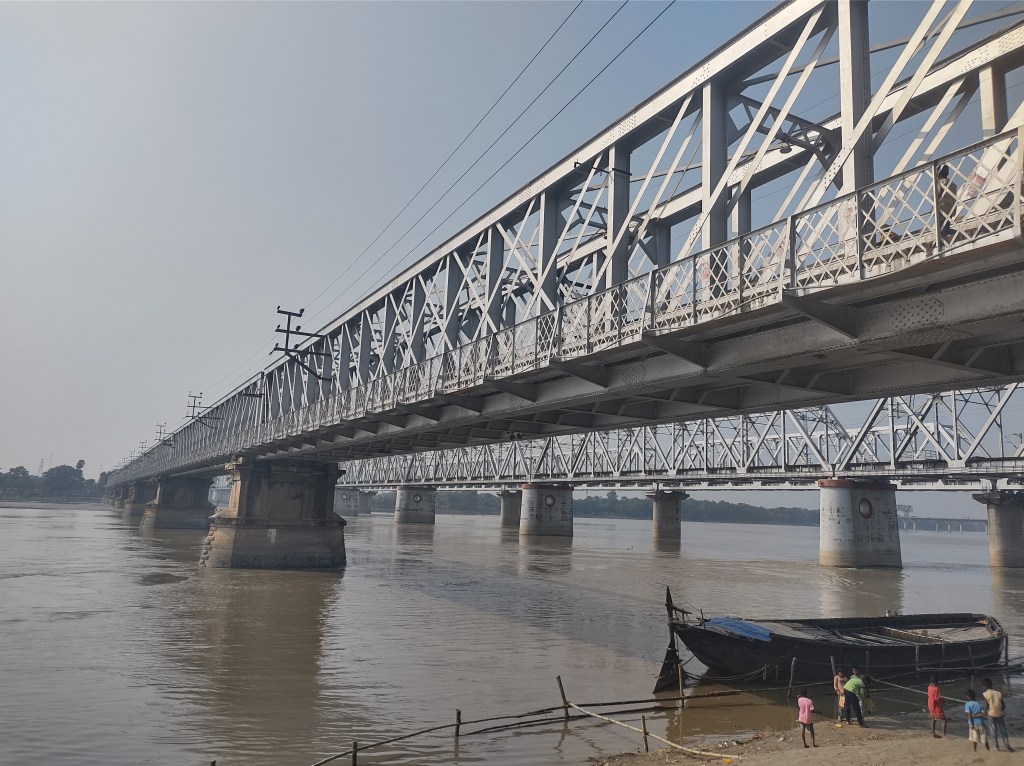
Finally, I reach to the twin towns of Hajipur and Sonepur
A region that is known as Harihar-kshetra
A region where story of Gaj-Grah ends
A region that was developed to facilitate trade with Patna
A region where at last I meet Ganga
To accompany her on her journey
A journey that ends into the abyss of Bay of Bengal
Read the whole visual narrative of the fellowship at:
https://www.livingwatersmuseum.org/synchronicity-of-nature-and-culture-along-gandak-river
Sources:
- Chaudhary, P. C. (1962). District Gazetteer of Champaran. Patna.
- Chaudhury, P. R. (1962). District Gazetteer of Muzaffarpur. Patna.
- Singh, D. S. (2018). The Great Gandak River: A Place of First Republic and Oldest University in the World. The Indian Rivers: Scientific and Socio-economic Aspects.
 Echoes of Time
Your Ode on Gandak encompasses the origin and sojourn of this sacred river.You should read Satish Chandra Mathur’s literary essay ,’O Sadanira’.He has narrayed the entire course of the Gandak.It was not a curse in the ancient times as dense forest absorbed its water in rain.
LikeLiked by 1 person
Thank you for your kind words. I will definitely have a look at the essay.
LikeLike