
**This post is a continuation of an earlier post titled ‘Ruins of Vaishali’.
Over time, due to growth of power in Magadh, the prominence of Vaisali started to diminish but it was still an eyesore for the kings of Magadh. Ajatshatru, the son and successor of Bimbisara of Haryanaka dynasty and a contemporary of Mahavira and Buddha, waged a war on Lichchhavis in between 484 – 468 BCE. While the power was transferred to Magadh, Vaisali still remained the focus of political and religious aspects and in 383 BCE the second Great Buddhist Council was held here in the reign of Kakavarni Kalasoka[i].
During the rule of Mauryan Empire, Vaisali was a part of the kingdom and was located on the royal road from Pataliputra to Nepal. Ashoka commissioned the construction of a stupa and a lion pillar at Vaisali due to the immense value it held for followers of Buddhism and Jainism. After that Vaisali finds mention in the travelogue of Hiuen Tsang who visited the region in 635 AD. He mentions that there were numerous monasteries in the city and its vicinity, so much so that it was difficult to get an exact number. However, unlike Jainism, Buddhism was in decline in the region.
After that Vaisali is lost in the history as it comes under Tirhut division and all the ancient structures that were once a symbol of this city’s prosperity are subjected to the same fate under subsequent rulers and invaders.
A ray of hope is seen in the colonial times where in addition to inflicting atrocities to the citizens of the country, British officials were also curious to rediscover the secrets of India’s ancient past. Owing to its importance in the Jain and Buddhist scriptures, the city of Vaishali was identified near the village of Basarh by literary evidences.
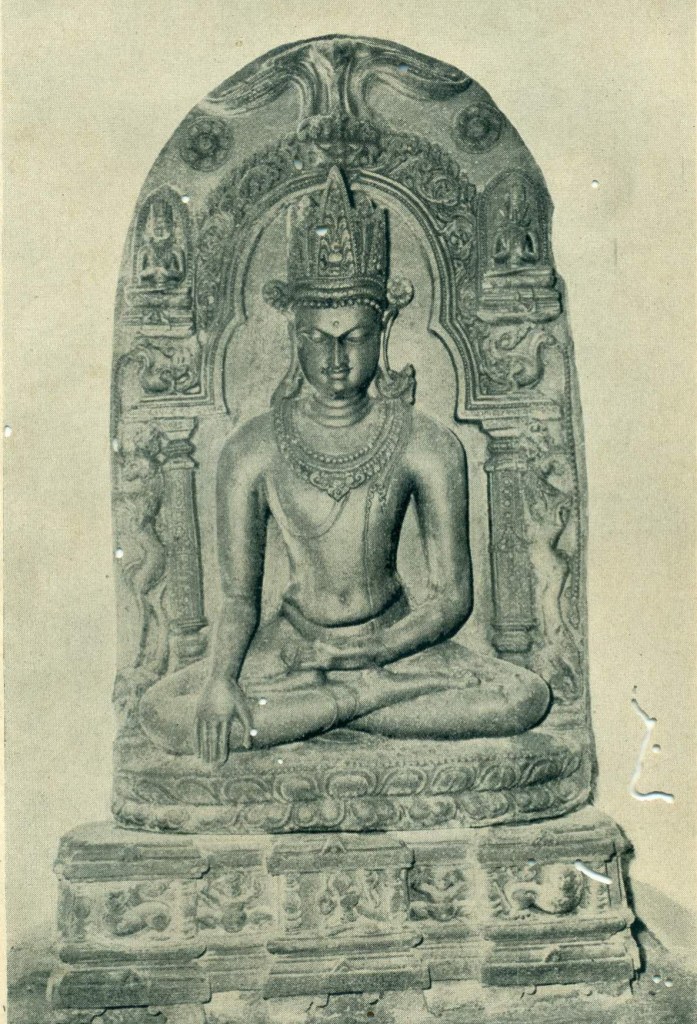

Right Image – Ashokan Pillar at Kolhua
Source – O’Malley, L.S.S. 1907. Bihar District Gazetteer: Muzaffarpur District. Patna.
Excavations were carried out since the days of Cunningham which revealed the garh or fort of Raja Vaisala made in brick in addition to several terracotta figurines, stone tablets, coins etc.


Right Image – Ivory and Bone objects uncovered in excavations at Vaishali
Source – O’Malley, L.S.S. 1907. Bihar District Gazetteer: Muzaffarpur District. Patna.
The garh is located at a higher elevation than its surrounding areas and measures 520 m by 245 m. It has remains of round towers or bastions at each corner and a 40 metres of moat that runs all around.

Source – https://tourism.bihar.gov.in/en/destinations/vaishali/raja-vishal-ka-garh
A kilometre away from the garh is Abhishek Pushkarini or the coronation tank. Water of this tank was considered sacred by the Lichchhavis and was used to anoint the newly selected members of the republic. It might have been the importance of the tank for Lichchhavis that enabled them to bury the relics of Buddha nearby as the excavation done in 1958-62 by A.S. Altekar and Sitaram Rai lead to the unearthing of the said casket. The casket with the remains was eventually transferred to Patna Museum in 1972. Remains of the mud stupa erected by the Lichchhavis were also uncovered during the excavation. Owing to the significance of this site, a Vishwa Shanti Stupa was constructed to the southern side of Abhishek Pushkarini in 1960s by Nipponzan-Myohoji sect of Japan.
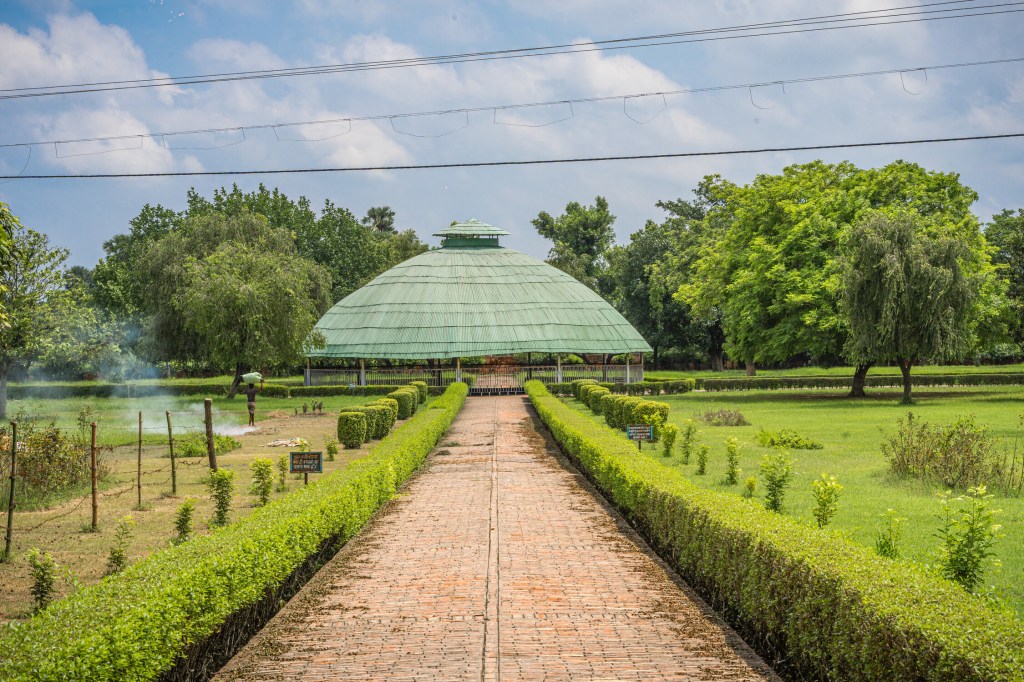
Source – https://tourism.bihar.gov.in/en/destinations/vaishali
Few kilometres away from this site is the famed Ashokan Pillar of Kolhua, made of highly polished single piece of stone which is 18 metres high and surmounted by a figure of a lion. The stupa that was established along with the pillar is more or less intact with its height being 20 metres and diameter 4.5 metres. It is also the site of Kutagarasala Vihara (the place were Buddha used to stay on his visits to Vaisali) and the remains of the two storeyed hall can be seen around the pillar in form of brick walls. It might have been the significance of this vihara that enabled Ashoka to establish a pillar and a stupa here. Nearby, there is also an old tank known as Ramkund.
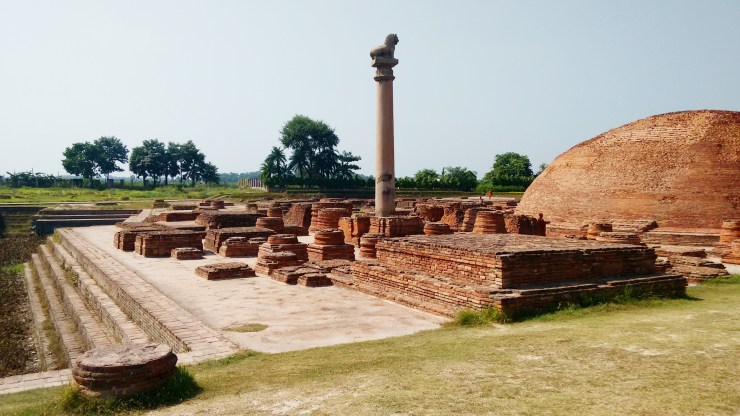
Source – Author
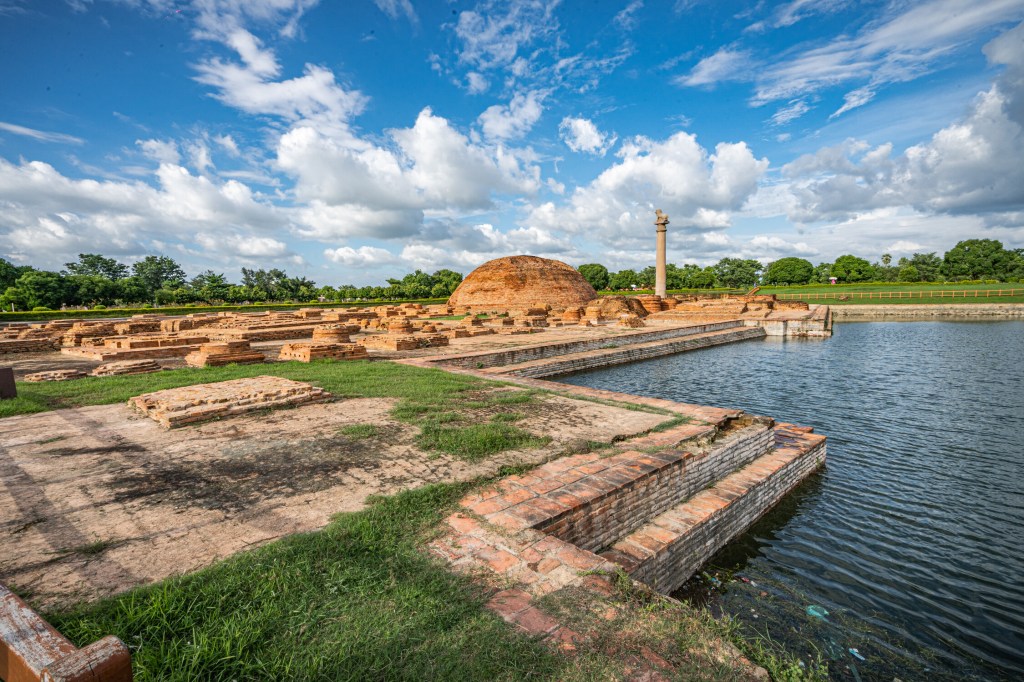
Source – https://tourism.bihar.gov.in/en/destinations/vaishali
Now that I have given a factual description of what our eyes can see on the ground today, it is also essential to understand what those facts represent in the present scenario. Having visited these sites a number of times I had an understanding of their significance but neither was I aware of the larger picture that these sites portrayed nor did I know the stories behind our current identities that they were trying to narrate. I know these words don’t hold any meaning unless I relate it to a scenario and for that I will recount an incident from my past.
It was quite normal for us to visit Patna at least once in a month for family events, school trips, or any gatherings. During those visits I noticed that the way of speaking and the words used in a conversation in Patna were slightly different from what I was used to back at home. It was not something that I could not understand but there were dissimilarities. Always counting on my grandfather to solve such queries, I turned to him and he informed me that the language we speak at home is known as Bajjika while in Patna people speak Bhojpuri, Magahi, and some other dialects. After processing this information, my younger self was confused and not able to comprehend as to why we spoke a different language from people who lived just an hour away but I dismissed that thought as it did not seem important at that time. However, somewhere that thought stayed in my head and over time I started to notice more differences in other cultural aspects of different regions of Bihar. While I started to educate myself more about the region and it historical evolution in order to understand those differences, research that has gone behind writing this piece has been a real eye opener.
What my younger self did not understand was that the river that could be crossed in an hour’s drive then, acted as geographical boundaries of different political or cultural regions in primeval world. The river that divides north and south Bihar today, served as the boundary for a republic and a kingdom in ancient India; two great powers that were different in every aspect be it political system, administration, cultural and traditional practices, rituals, lifestyle, or the language. Yes, language! I was surprised to know that Vajjika was the official language of the republic of Vajji or Vriji which over the years became Bajjika. Due to the proximity of regions of Vajji and Mithilanchal, Bajjika had strong influence of Maithili but no such contribution came from Bhojpuri or Magahi as they were language of a different region, and hence the differences. So, after finally finding an answer to the question that popped in my mind so long ago, I feel a lot closer to the place that I was born in. Of course it would have been much easier and quicker if I would just have asked someone about it, but what’s the fun in that. The thrill of embarking on a journey which leads to discoveries like these is incomparable, especially when you are a step closer to finding out your origins.
I know I am not wrong when I say that most of us has a certain inclination towards finding out where we came from. Presently we do have the technology that can trace one’s ancestry up to five generations by using DNA sequencing, but is that enough? Is it where we should draw a line and forget about the generations before that? My answer would be no, because it is human being’s thirst for knowledge of their origin and evolution that have led to thousands of discoveries related to our past. Today, we might not care about history or might forget details of the past but does it really leave us or is it continuously shaping our identities and realities even today? Food for thought!
[i] Kalasoka was the successor of Shishunaga, the founder of Shishunaga Dynasty. Shishunaga was a son of a Lichchhavi ruler and an official of Magadh Empire in Haryanka Dynasty. He was placed on the throne by the people who revolted against the Haryankas. His capital was at Rajgriha (modern day Rajgir) and he maintained a second royal residence at Vaishali.
Sources:
- O’Malley, L.S.S. 1907. Bihar District Gazetteer: Muzaffarpur District. Patna.
- https://www.britannica.com/place/Vaishali
- https://tourism.bihar.gov.in/en/destinations/vaishali/
Featured Image Credit – https://tourism.bihar.gov.in/en/destinations/vaishali/raja-vishal-ka-garh
 Echoes of Time
pondering over lineage! *high five*
LikeLike