
In the summer of 2015, after the completion of 2nd semester in Masters of Architectural Conservation, I was required to do an internship of two months in the field. While most of my batch mates had landed on amazing opportunities, I was still looking for something different. After sometime, I along with one of my friend, seized an internship in Archaeological Survey of India, Shimla circle. We both were really excited as it was a chance for us to explore a completely different region of India and we were going to spend two months in Shimla, away from the scorching heat of Delhi.
When we arrived in Shimla, we were asked us to visit some of the sites in the state of Himachal Pradesh by the Superintending Archaeologist (SA) to familiarize ourselves with the properties that were under the protection of ASI and subsequently choose the site that we were interested in working on. So, we spent the next three days visiting different sites in Himachal Pradesh namely Shiva temple in Gumma village, Rock cut temples of Masroor (Kangra Valley), and submerged temple of Bilaspur. While all the three sites were fascinating, I was completely awestruck by the temples of Bilaspur.

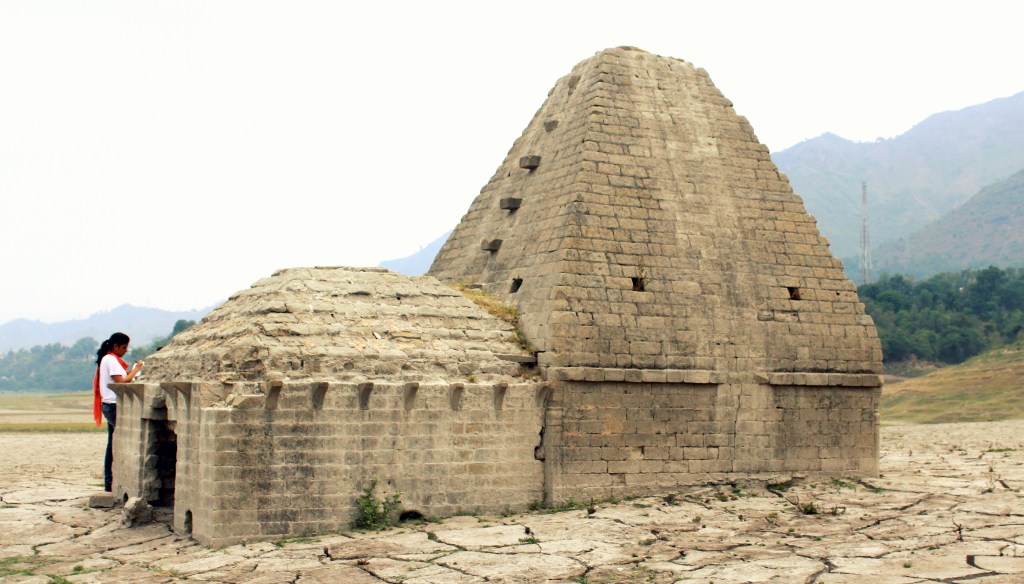
Bilaspur was last on our itinerary, and after the pleasant weather of Kangra Valley, the city welcomed us on a hot summer day of June. Completely unaware of what the site was, we reached Nahar Singh Dhaulra temple, one of the sacred sites in Bilaspur. From the vantage point of the temple we could see three temples downhill, built in Nagara style. The first impression was a little disappointing for me seeing the size and condition of the temples but when we started walking towards them, I could see more structures. Arriving at the ground level of the temples I observed cracks on the ground, some as wide as 10-15 cm. Since I was completely unaware of the history of the place, I was unable to fathom as to where we were standing and how are these structures standing here with no context of their own. The officer who was assisting us advised to see all the structures and their surroundings first and later research about their history and their present condition. We agreed and started inspecting every temple, there were a total of 11 temples spread across a distance of 2.5 kilometres.
Later, with some research, we were able to get a brief history and timeline of the historic city.
Bilaspur was a princely state settled along the Sutlej River where the river breaks away from the middle range of the Himalayas. The state was established by Chandel Rajputs who claimed their descent from Sissapal of Chanderi in southern Rajputana. The dynasty was started by Raja Bir Chand in 697 A.D. when he established the principality of Kahlur and ruled till 730 A.D. Little is known about his successors until the reign of sixth king, i.e. Raja Kahul Chand who succeeded to the throne in 894 A.D. and established his capital at Kot-Kahlur or Kahlur Fort. Presently, the fort is located near Naina Devi Temple and at a distance of approximately 55 kilometres from the city centre. The state also has connections with the Sultante rule of Delhi. Raja Megh Chand, the seventeenth ruler of the state was exiled after few years of his succession of throne as he was not a popular ruler. He received help from the Emperor of Delhi Shams-ud-din Altamash in restoring himself on the throne of Bilaspur in late 1260s. Later in 1653, after the succession of throne by Raja Dip Chand, capital of the state was transferred to the left bank of river Sutlej and was renamed as Bilaspur.
Post-independence, on 1st July 1954, Bilaspur was integrated as a district into the state of Himachal Pradesh. In 1955, the construction of Gobind Sagar Lake was commenced on River Sutlej, which is a reservoir for the Bhakra Dam. With the creation of Gobind Sagar Lake, whole historic town of Bilaspur was submerged, and with it all the evidence of the glorious past were lost except for some temples. These temples are located on the river bed of Sutlej, some of which are half buried in the silt of the river. In the summer, due to low water level, this temples become visible and large cracks are seen on the river bed in the absence of water. During monsoon, which hits this city in the month of July, the river attains its full strength and all these temples get submerged in the mighty river. The constant submergence and emergence of these temples happens on an annual basis with the arrival and departure of monsoon. All these pressure which gets exerted on the temples, have led to their deterioration and some of them are in a pretty bad shape.
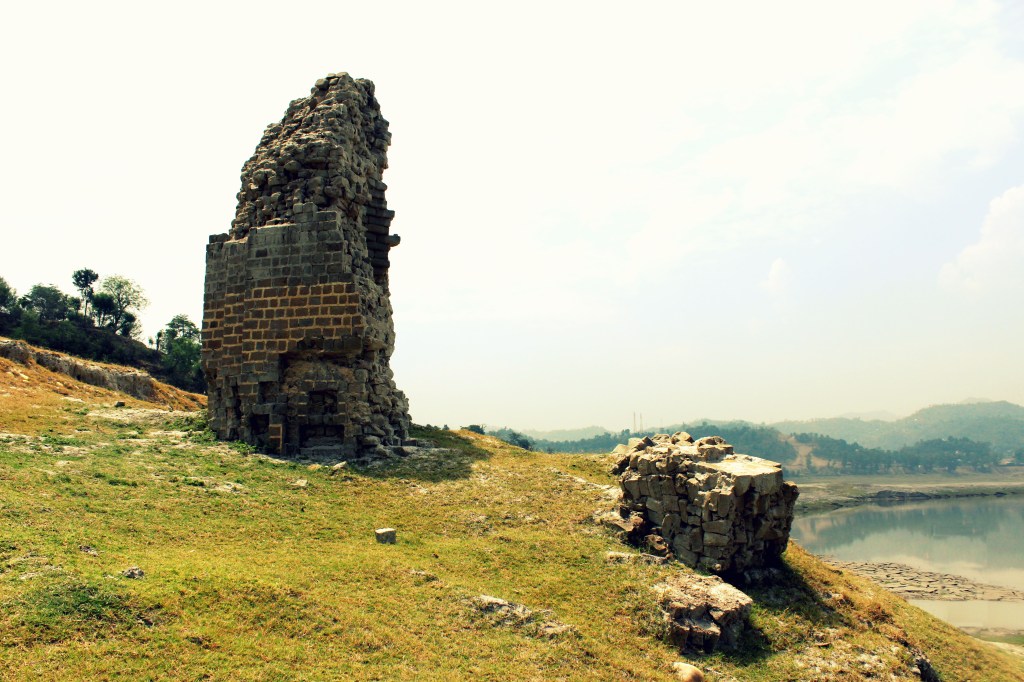
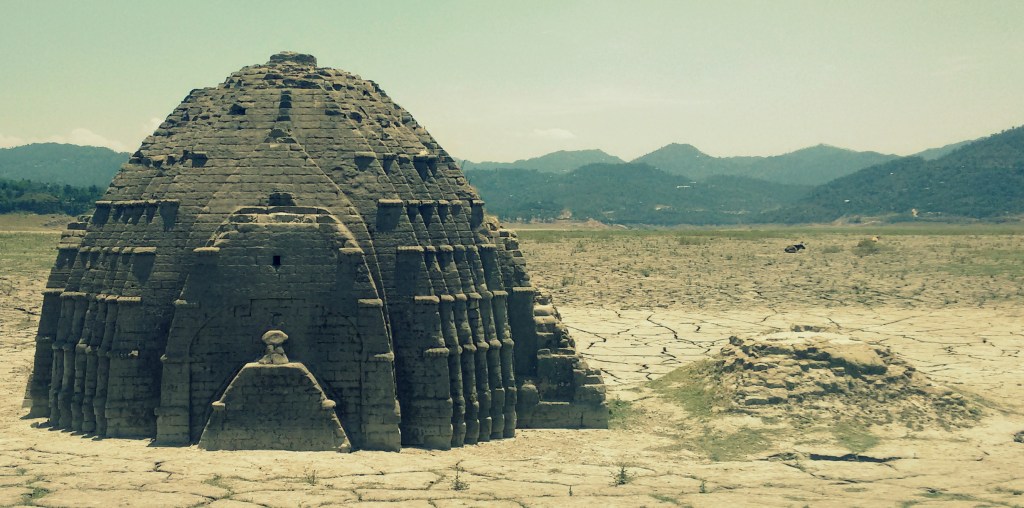
To protect the temples from getting damaged on an annual basis, the office of ASI Shima Circle was working on a proposal of translocation of all the temples to a higher ground and we were asked to get involved in the initial documentation and condition mapping. In lieu of the interesting history and exciting nature of the site, we started working on the initial documentation which took a week of toiling in the hot weather of Bilaspur.
For now, the chronicles of Bilaspur does not end here, as the next article will be on the exploration of each temple that we found on the river bed….so keep reading!
Sources:
- 2017. Bhakra Beas Management Board. https://bbmb.gov.in/bhakra-project.htm.
- 2018. Bhakra-Nangal Dam: History, features and facts about the second tallest dam in Asia . New Delhi, October 22.
- Brentnall, Mark. 2004. The Princely and Noble Families of the Former Indian Empire. New Delhi: Indus Publishing Company.
- District Bilaspur. https://hpbilaspur.nic.in/history/.
Featured Image Credits – Neha Mallick
Neha Mallick is a Conservation Architect and presently an Assistant Professor at Sushant School of Art and Architecture. We have been batch mates in Bachelors as well as Masters and have worked on this project together, as a part of internship in ASI, Shimla Circle.
 Echoes of Time
Being a Himachali, I couldn’t resist myself from reading this one. It is disheartening to read about the history being ruined by the modern construction but at the same time, it gave me an immense satisfaction that you guys are looking for a solution to preserve these beautiful pieces of history.
LikeLiked by 1 person
So glad that you liked it…keep reading!
LikeLike
Hi Neha,
I am a PhD scholar at IIT Delhi, an urban planner and an architect. I have recently visited the Bilaspur site and however extensively I tried I could view only 7 temples. I would love to connect to you and further discuss about these temples.
LikeLike
Hi, I am sorry I saw your message today only. Let me know what it is that you need.
LikeLike
I just opened up the blog after long. Thanks for the reply.
LikeLike