
Exploring a new place has been vehemently romanticized in the modern world due to the invention of digital space and social media platforms. We have all been transformed into travel vloggers/bloggers and are constantly on the hunt to discover an unexplored destination. While the phenomenon has brought some places in the limelight, the format of 3-minute reels and an Instagram post rarely does justice to the cultural and historic perspective. With the city of silk, it has been quite a personal journey, and it was difficult to showcase all that through social media formats. Hence, the decision to execute a series of posts which captures the essence of Bhagalpur throughout different periods of history.
In the previous post titled Mystery of Karnagarh and Medieval History of Bhagalpur, I have given a glimpse of the medieval landscape under the reign of Palas of Bengal, Sharqis of Jaunpur, Lodis, and the Mughal Empire. This post starts with the late 18th century when Shah Alam II reigned and the sun was setting on the Mughal empire. In 1765, diwani or revenue administration of Bengal, Bihar, and Orissa was granted to the East India Company and during this time Bhagalpur was a part of Sarkar Munger.
Further down the years, i.e. in 1769, a British officer named William Harwood was appointed as the first supervisor for the local collection of revenue. During that period, Bhagalpur was not a separate revenue area as it was under the supervision of Rajmahal (presently in Jharkhand). In 1774, William Harwood was succeeded by Barton who continued to be in office till 1779 and then he was succeeded by his own assistant, Augustus Cleveland. Cleveland was not only appointed as supervisor, but he went on to become the first collector of Bhagalpur and remained in office till 30th November 1783. With the accession of Collector’s office, Cleveland started making strategies to subjugate the tribal chiefs of southern Bihar (presently includes the area of Jharkhand as well). These hilly ranges were controlled by tribals, or Adivasi community and they were protecting their land from acquisition by East India Company. These lands were considered sacred by the community and hence the struggle to save it from destruction.


Source – District Gazetteer of Bhagalpur
The protest was not accepted by Cleveland, and he launched various operations to subdue the community. However, during one such conquest he was executed by the rebellion leader Tilka Manjhi. Tilka Manjhi was a notable tribal leader and is considered as one of the earliest figures who rebelled against British Raj. His actions were in retaliation against the great Bengal Famine of 1770 and precursor to the Santhal uprising. Cleveland died at an early age of 30 and two memorials were erected in his honor by the Court of Directors of East India Company. One of the memorials is situated in the premises of Tilka Manjhi University while the other is in the confines of Sandy’s Compound. After Cleveland, Bhagalpur saw a succession of British officers and with them came various travelers who have written a great deal about the town.


In 1824-25, when Bishop Reginald Heber (an English Anglican Bishop who served as Bishop of Calcutta) visited Bhagalpur, he mentioned that although the town was well situated and was said to be ‘one of the healthy stations in India, it was infested with snakes.’ Another reference of the district and the town is mentioned in Captain Sherwill’s Geographical and Statistical Report. He was the Revenue Surveyor of the district and mentions:
“The most remarkable objects in the pergunnah are first the town and station of Bhagalpur. The town is a miserable straggling collection of huts, extending over four miles of ground cut up and divided by fields, gardens, plantations, and numerous roads, the whole plan resembling an uninhabited forest rather than a town. Chumpanaggur and Luchmeegunje, two large contiguous towns, lie immediately to the west of the old Karrungurh Fort, and form a portion of the town of Bhagulpoor; these towns are filled with weavers, traders, and dyers, and have numerous markets. Nathnaggur, another large town lying a little to the south of the two former towns, is also full of gram-dealers, traders and markets and is highly populous. Kurrungurh, a high raised mound nearly two miles in circumference, is the site of the cantonment of the Bhagulpoor Hill Ranges. At Chumpanaggur, which is at the extreme west of the town, are the remains of Jain temples.”
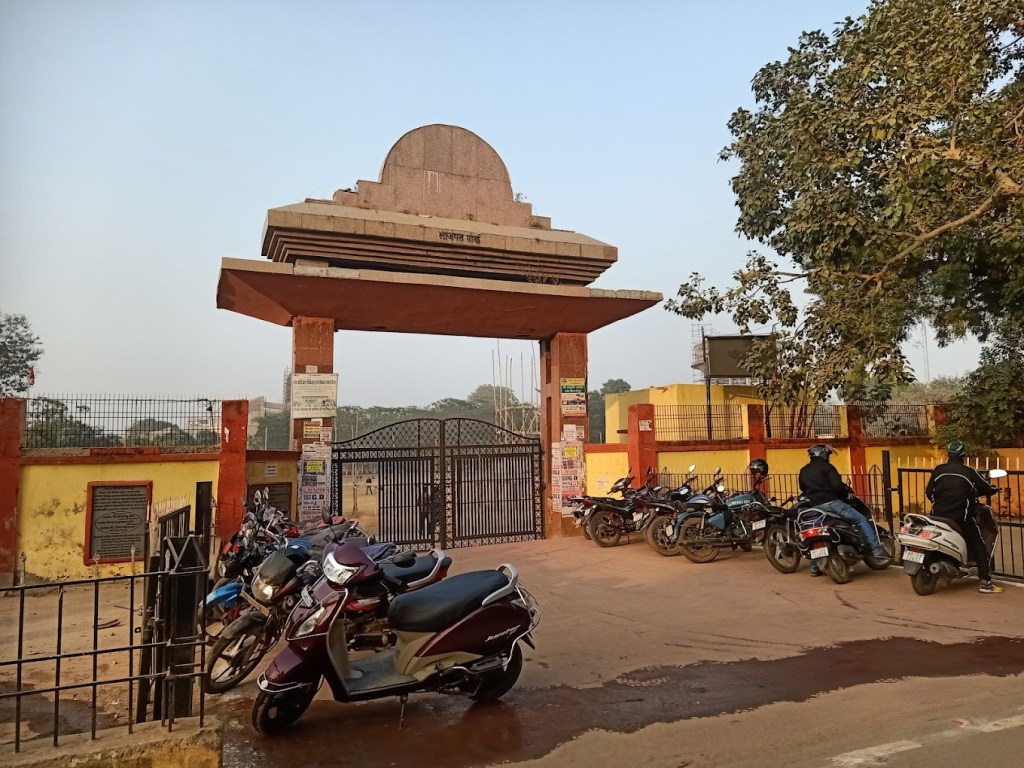
Later, the rebellion of Tilka Manjhi acted as a catalyst for the freedom struggle as the people of Bhagalpur participated in the freedom movements led by Mahatma Gandhi and showcased strong reactions to events like the Jallianwala Bagh Massacre. Meetings, hartals, and picketing were organized in large numbers, where the students remained at the forefront. Lajpat Park situated in the midst of the town was a major center of these movements and its name was suggested by Mahatma Gandhi as the place was graced by Lala Lajpat Rai in 1920, during Non-Cooperation Movement. It was also visited by S.C. Bose in 1940. Later in August of 1942, several assemblies of August Kranti were organized here[1].
After independence, the city has seen several changes, but it remains a beacon for people who are interested in unraveling the stories that are hidden in its lanes. With its manifold narrative, Bhagalpur is still considered as one of the flourishing cultural centers of eastern Bihar. Presently, these stories can only be experienced through architecture, art and craft, and oral traditions. In the next post, I will attempt to tell these stories through the lens of tangible and intangible heritage that have become a part of the city’s fabric; till then, happy reading!
[1] https://www.livehindustan.com/bihar/bhagalpur/story-lajpat-park-has-been-a-witness-to-the-august-revolution-memorials-were-made-3409436.html
Sources:
Chaudhury, P. R. (1962). District Gazetteer of Bhagalpur. Patna.
 Echoes of Time