
In the previous posts, I have mentioned about some places in Bihar which were centres of trade & commerce, mostly from the period of Mahajanapadas. While the information is enough to establish the significance of these ancient cities, it is not helpful in portraying the role that these places played in the regional, national, and international trade. So, through a series of two posts, I have attempted to shed light on the ancient routes of eastern India, mainly concentrated on the region of Bihar and Bengal, which proved efficient not just for trade but for cultural and intellectual exchange as well. The first post is focused on one of the important trade centers of eastern India, as it is impossible to dive into the web of ancient trade routes without learning about this place.
Tamralipta or Tamralipti, a place significant in the trade and commerce scenario of India, was an ancient port city situated in Bengal. It is said to be the capital of Suhma kingdom which was an ancient empire that rose to prominence during the Late Vedic Period, and it included the region of present districts of Midnapore (undivided) and parts of Hooghly and Howrah. The name Tamralipta is derived from Sanskrit terms ‘tamra’ (copper) and ‘lipta’; conjointly meaning ‘full of copper’. Copper was mined in the Singbhum region of Chhota Nagpur Plateau and was traded through this port, which essentially gave the port its name. Presently, the city is identified with Tamluk town of Purba Medinipur in West Bengal.
Source – https://en.unesco.org/silkroad/about-silk-roads
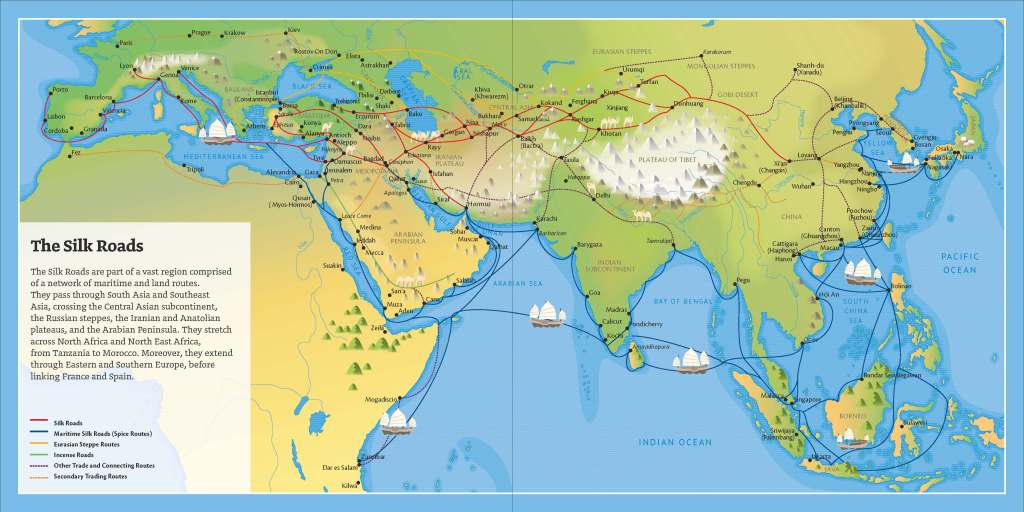
The city commanded an entrance and exit from the eastern side of Indian sub-continent as it was situated near the coastline of Bay of Bengal and close to the confluence of Rupnarayan and Ganga River. Tamralipta had strategic geographical advantages which helped in establishing connections with major commercial centers of India and the world. Its location made the port as dronimukha type of sea-port which implied that it was located near the confluence of a river and sea. Evidence of its antiquity can be found in literary sources such as Mahabharat, Dashakumaracharita[i], Kathasaritsagara[ii], Jataka tales, and works in Pali literature where it is mentioned as ‘Tamalitti’ or ‘Tamalitthi’.
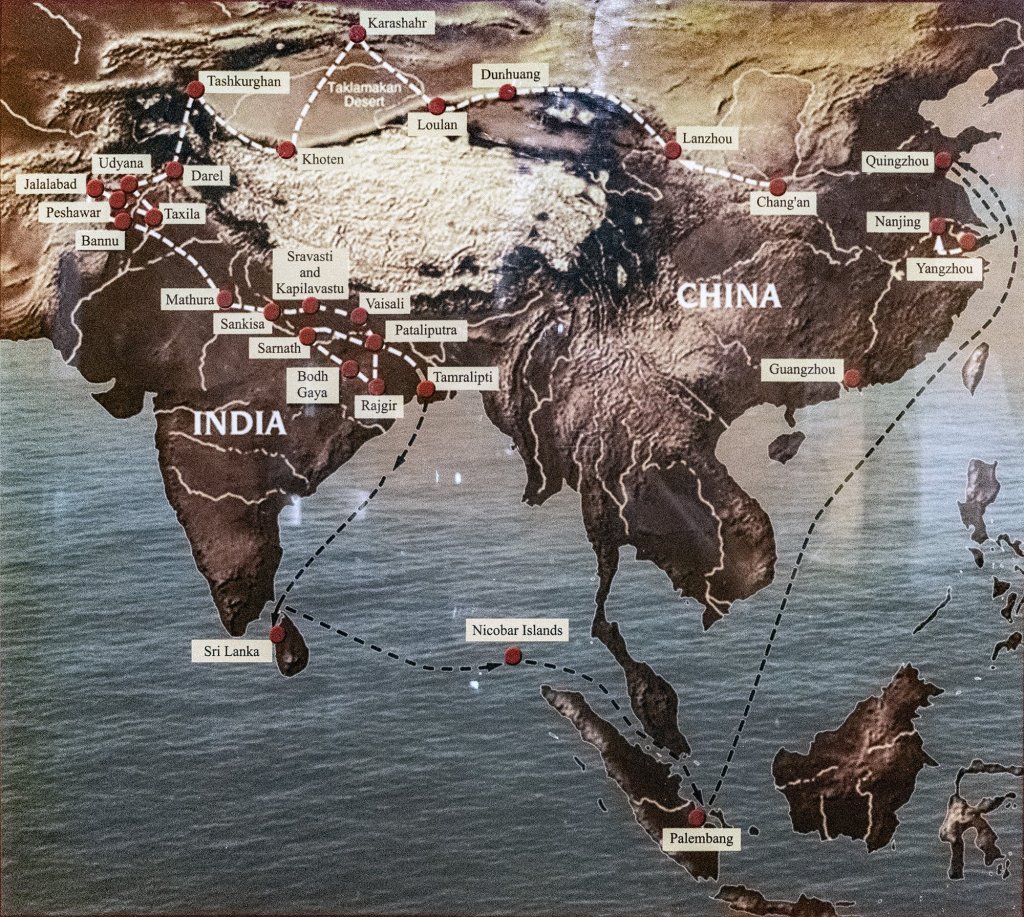
The region flourished from 3rd century BCE to 7th century CE and became an integral part of Kalinga. It is believed that such was the status of this place that Ashoka invaded Kalinga just to control the access to the ports. Records also state that from the port of Tamralipta, Ashoka’s son, Mahendra, and daughter, Sanghamitra, sailed to Ceylon (Sri Lanka) and Suvarnabhumi (Thailand). The envoy carried seeds of Bodhi Tree and Buddhist scriptures in an attempt to spread Buddhism to other parts of the world. The city is also mentioned in the travelogue of Chinese travelers Fa-Hien (stayed in Tamralipta for two years), Hiuen-Tsang, I-Tsing (visited India between 673–693 CE and stayed in the city for five months).
Source – https://www.wisdomlib.org/gallery/galle-national-museum/7789
Literary sources mention the existence of trade with Sri Lanka, Thailand, Java, China, and some western countries as well such as Rome and Egypt. Moreover, archaeological excavations carried out in several stages, in and near Tamluk town, confirms the existence of trade routes with rest of Indian sub-continent and different parts of the world. Apart from spiritual and cultural exchange, the port helped in boosting the trade of indigo, silk, copper vessels, and spices among several other items. However, usage of the port declined from 7th century CE onward where a number of geographical and political factors acted as a catalyst such as silting of the river port and change in the path of the river combined with de-urbanization of coastal Bengal.
Source – https://images.ashmolean.org/asset/8781/
While at present, the magnificent city which served as eastern gateway to India, is only reminisced through the small town of Tamluk, its contribution as cultural and commercial melting point should not be forgotten. This piece does not remotely do justice to the significance of Tamralipta but I hope it was a decent attempt. The next post will focus on the trade linkages between Bengal and Bihar, essentially providing a glimpse into the ancient routes of India. Till then, Happy Reading!
[i] A prose romance in Sanskrit, attributed to Dandin, which is believed to have flourished between 7th and 8th century CE.
[ii] A 11th-century collection of Indian legends and folk tales
*Featured image generated from AI – Doesnot truly depict the nature of Tamralipta, has only been used for imaginative purposes.
Sources:
- Kumar, Anil. “MARKET CENTRES AND TRADE ROUTES IN LATE ANCIENT BIHAR.” Proceedings of the Indian History Congress 67 (2006): 131–44. http://www.jstor.org/stable/44147930.
- Akhtar, Sharmin & Idris, Hanizah. (2022). Ancient Trade Corridor Tamralipti and Bengal’s Glory (200 BCE–700 CE). KEMANUSIAAN The Asian Journal of Humanities. 29. 1-22. 10.21315/kajh2022.29.1.1.
- Jayasuriya, Kasun. (2023). Tracing the Ancient Trade route from Rājagṛiha to Tāmraliptī during the period of 3rd Century BCE to 6th Century CE. 2. 121-138.
- https://www.wisdomlib.org/history/essay/history-culture-and-antiquities-of-tamralipta/d/doc1455682.html
- https://www.peepultree.world/livehistoryindia/story/lost-cities/tamralipti-the-ancient-copper-port?srsltid=AfmBOoo9eJmvituPNNv30Etc2yXYKozhXCO4AJr-IiD9tQtX7T68ksC0
 Echoes of Time