
(This post is a continuation of the last post titled ‘Manjusha: An Art form of Anga)
The last post on art form of Manjusha ended with an introduction of the folklore which inspired these paintings. ‘Bihula-Bishahari Gatha’ or the story of Bihula-Bishahari is an extremely important part of the oral tradition of this region. Bishahari Puja, which is celebrated in the month of August (around Naag Panchmi) every year, is also a celebration of the folklore of Bihula Bishahari. The story illustrates the origin of Goddess Manasa Bishahari and her four sisters and how they attained importance in life of residents of this region.
Ishakchak, an area in Bhagalpur boasts of one of the main temples of Goddess Bishahari besides Champanagar. This temple is in possession of an old manuscript (of over a 1000 pages) which tells the story of Bihula Bishahari and is written in Kaithi or Kayasthi lipi, a script which is almost extinct now.

Courtesy – Shri Madan Lal (Main priest of Ishakchak temple)
With an understanding of the art form of Manjusha and the region it originated from, let’s explore the folklore of Bihula-Bishahari:
It is said that one day Lord Shiva was taking bath in Sonada Lake and 5 strand of his hair broke and fell into the water. These strands became 5 lotuses at the bank of the lake and a sound starts coming from the lotuses.
All 5 of the lotuses request Lord Shiva to accept them as his daughters to which Shiva replies that without seeing their true form, he cannot accept them. All 5 lotuses convert into their true forms of 5 women. They are 5 sisters, and their names are:
• Jaya Bishahari
• Dhothila Bhavani
• Padmavathi
• Mynah Bishahari
• Maya bishahari / Manasa bishahari
Lord Shiva accepts these 5 women as his “Manasaputri” which means he accepts them as his daughters in the human form.
The five sisters go to Goddess Parvati and asks her to accept them as her daughters, to which she refuses. The sisters get agitated, and they turn themselves into their snake form and hide in the flowers. When Goddess Parvati goes to pick the flowers, the snake bites her and she becomes unconscious. Lord Shiva comes and requests them to revive her after giving an assurance that she will accept them. Jaya Bishahari feeds Goddess Parvati amrit (nectar of life) from her kalash and revives her. Parvati grants them a boon saying that they can get rid of the snake’s poison and were called as “Bishahari”.

Courtesy – Sujit Kumar
After some days Lord Vasuki Nag went to meet the five sisters and they inform him that now they are a part of Lord Shiva’s family. They express a wish of being worshipped by humans as every member of Shiva’s family is worshipped. Lord Vasuki Nag replied that in the capital of Angpradesh i.e., Champanagar there is a devotee of Lord Shiva, and his name is Chando Saudagar. If he accepts to worship them then everyone on earth will follow. On hearing this, the 5 sisters ask Lord Shiva’s permission to approach Chando Saudagar and head towards Champanagar. Chando Saudagar was a very successful businessman and had six sons. When the sisters approached him and asked him to worship them Chando Saudagar replied that since he did not know who they were he will not worship them. On hearing this Mynah Bishahari gets angry and curses him that if he will not worship them then they will ruin his business and kill his family. Even on hearing this, he refuses to worship them.
A few days later, Chando Saudagar was travelling with his sons on a boat when Bishaharis drowned the entire family. However, after some time they realised that if they drowned Chando then their wish of being worshipped would not be fulfilled. So, all the five sisters prayed to Lord Hanuman, and he pulled out Chando from the river. After this incident, Chando Saudagar was angry with Bishaharis and refused again to worship them. Few years passed by, and wife of Chando gave birth to another son who was named as Bala Lakhendra. Once the son grew up, they started searching for a bride and his marriage was fixed with a girl known as Bihula who was from Ujjain.
For the couple’s wedding night, an iron house was constructed to make them safe from the threat of Bishaharis. This house was constructed by no other than the Daivashilpi Vishwakarma. However, Bishaharis had intercepted this plan and had requested him to leave a small hole as fine as a hair in a wall of the room. Bishaharis managed to get Lord Shiva’s snake ‘Maniyar’ to enter the house and kill Bal Lakhendra. Bihula was distraught at her husband’s death but as Chando was about to order that his son’s body should be immersed in the river, Bihula stops him and says she will travel with his body and approach “Nethula Dhobin” to revive him. Bihula orders Vishwakarma to construct a boat for her along with a cover for the body. She also requests an artist to draw the story of her tribulations on the cover in which all her family members were depicted along with all the flora and fauna of Ang Pradesh. The colours were used such that sacrifice, determination and happiness were portrayed. The cover was known as Manjusha.

Source – Author, Courtesy – Soma Roy

As Bihula takes her husband in the manjusha, she sees one woman with two other men. She was Nethula dhobin. Bihula saw her cut her husband into “koota” and the son into a “paat”. She washes her clothes and once she is done with certain mantras she brings back her husband and son alive and then they continue on with their work.

Bihula witnesses this and realizes that she can help her in reviving her husband. Bihula approaches her and requests for her help. After a lot of trials and tribulations, Bihula manages to approach Lord Shiva in heaven and there she conceals her face by wearing her ghoongat or veil. She requests Lord Shiva that all the wealth of her father-in-law should be returned to him. She also asks him the happiness of having children and that all her sister-in- laws who were widows should become “suhaagan” again.
After her boons were granted by Shiva, she removes her ghoonghat and Bishahari recognizes her as Bihula. At that point Bishahari tells her that all your boons will come true only on one condition that you will make sure that Chando Saudagar will worship her and her sisters. Bihula agrees and assures her that she will get the pooja done. Bishahari brings Bala back to life. The entire family with the sonamukhi boat and their wealth head back to Champanagar. Chando Saudagar accepts this and starts worshipping the five sisters.
So, the art form is a scene-by-scene depiction of this folklore and is hugely celebrated in the region.
Characters and Motifs in Manjusha art
All the characters in the story have a specific symbol. Human forms are depicted in the form of letter ‘X’ with limbs of human form raised in same manner. The main characters are portrayed with big eyes and without any ear. Bishaharis are represented in the same way except they can be distinguished by what they hold in their hands.
Symbols of the five sisters are explained below:
• Jaya Bishahari – Bow & Arrow + Amrith Kalash in one hand and in other a snake
• Dhothila Bhavani – One hand the rising sun and in the other hand a snake
• Padmavathi – Lotus in one hand and in other a snake
• Mynah Bisahari – Mynah in one hand and in other a snake
• Maya bishahari / Manasa bishahari – Snake in both hands
Process of making the art form
When a painting is started for religious purposes, the artist makes a pile of rice in the room, places a beetel leaf with a beetle nut on top of this pile and prays for permission from the goddesses to start the painting. The moment the leaf shifts a bit or falls, they consider this as a sign that they have got permission and can start their work.
For the painting first an outline is drawn and then colors are filled in. The outline is usually drawn in green color but today some artists also use black color for making outlines. In traditional paintings, rulers and other instruments were not used as it was felt that the little imperfections made in painting without the instruments add to the raw nature of the art. But nowadays various instruments are used to make the paintings symmetrical and precise.
Borders are very important in a Manjusha Painting. Motifs named as Leheriya, Sarp Ladi, Tribhuj, Mokha and Belpatra are generally used for making borders. Sometimes, artists also use solid band of yellow, green or pink color after these motifs to enclose the painting and make it look complete.
However, in current scenario, artists have started experimenting a lot in to compose the painting. Apart from only depicting the folklore, they have started using the traditional motifs and character for composing abstract painting and other artwork while experimenting with the shade and hue of colors.

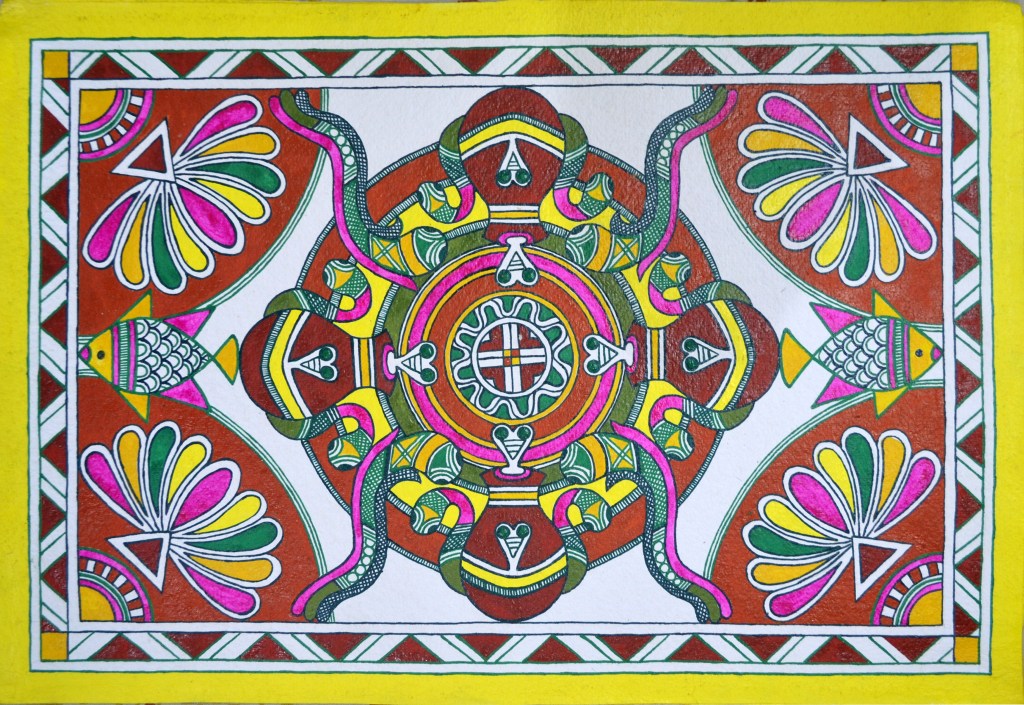
Today, the art form is equally popular as Mithila painting and has earned a Geographical Indication (GI) Tag as well.
Source
Upendra Maharathi Shilp Anusandhan Sansthan. (n.d.). Retrieved November 28, 2018, from Upendra Maharathi Shilp Anusandhan Sansthan: http://www.umsas.org.in/en/bihar-arts-crafts/manjusha-art/
 Echoes of Time
1 thought on “Manjusha: Folklore of Bihula-Bishahari”